
Showing posts with label WINNERS. Show all posts
Showing posts with label WINNERS. Show all posts

MY MIND IS MY EYE NOW,I CAN HANDLE ANYTHING -Pratish Datta

You did MSc in mathematics at IIT and are known to do complex mathematical calculations mentally.How is that possible
It goes back to my childhood.I lost vision in one eye at six months of age and had poor vision in the other.My parents felt that if I studied a lot,the pressure would damage this eye too.So my mother would read all my lessons to me and I would memorize them.Even maths sums were done mentally.I knew no other way to do it.Over time,practice made me perfect.I also manage to finish my exams in almost the same time as normal students.But a lot of higher mathematics is not just calculation but visualization too and I can handle that.Even Swiss mathematician Leonhard Euler lost his vision in the last 17 years of his life.But he continued to do research.My mind is my eye now.
How did you cope with the loss of your eyesight
I was doing my second year at St Xaviers College in Kolkata in 2008 when I lost vision in my second eye.I was shocked to suddenly see a dark world but my parents and teachers stood by me.As I loved studies,I decided to concentrate on that.All my happiness is related to studies.Even when I came to IIT,there were many questions about whether I would be able to cope.But my faculty helped me with a competent scribe,which itself takes the load off students like me.Hes a computer operator here who understands mathematics symbols and has done presentations for various seminars.The dean of student affairs also helped me find accommodation within the campus.I also have nice friends,especially Fouzoul Atik who studied with me in MSc.He would sit beside me,dictate what was written on the board,take me from one class to another,xerox pages for mehe was very happy when I got the gold medal.
Was it difficult
to handle the pressure in IIT with this impairment Your mother seems to have sacrificed a lot.
As I was able to see in childhood,I understood maths symbols and could do well.But for many others,the fact that higher education books arent in Braille are a handicap.An attempt should be made to convert them so that others like me dont suffer.As for my mother,she has stood by me like a rock.Even when I said I wanted to study in IIT,she told me bravely,Go as far as you want,I will be with you. And she did.She left Kolkata where my father is a civil engineer and came to stay with me,an only child,here at Kharagpur.
What should education institutions do for the visually challenged
They should be generous towards them and help them as much as possible.Such students already start with a disadvantage and could do with a legup in life.Give them competent scribes and good scholarships.
What do you plan to do now
I want to do my PhD in cryptology and network security as its a field which is gaining importance and involves both maths and algebra.I want to continue doing research.
You seem to lead a normal life you use the mobile quite well and have a Facebook profile.How do you manage these
I have memorized the keys and functions of my mobile so I can use it effortlessly.I also have a computer screenreading software called JAWS which reads out whatever text there is on it.
Your Facebook profile shows you having varied interests,including football and cricket.
I used to play cricket when I could.Now I just hear the commentary.
It also mentions that you like chattingwithhotgirls.Doesthathappen often
(Laughs) Its not like that.I have got some popularity after the award but its not like I chat with many girls.I am particular.
Two friends bound by muscular dystrophy take up the cause of unhindered mobility

Anjlee and Sanjeev have the distinction of conducting workshops on accessibility and barrier-free tourism both in India and abroad. “Barrier-free tourism can go a long way in integrating Persons with Disability in the mainstream society,” they assert. They point out that travel tours for persons with disabilities can be actually act as therapy for them. “When one goes to an unknown place, historical or inaccessible, one learns more. Through such exposure persons with disability develop a sense of confidence and a determination to fight against all odds,” the positive- spirited Anjlee and Sanjeev spells out their mantra. Besides such trips help create awareness on disability in all the places we go, they point out. Both have been the inspiration behind Samarthya which has been playing a pivotal role in advocating the vision of Anjlee and Sanjeev for a barrier-free world. Working for the past more than five years, Samarthya’s prime goal is to promote “Inclusive Society and Universal Design in the Built Environment and Transportation”.
"Every person with disability has the right to move out independently with minimum assistance and live life with dignity and grace. And it is our firm conviction that barrier-free tourism for disabled people can play an important role in integrating them into the mainstream of society..." So reads the leaflet describing Samarthya's goals. Samarthya for the past several years have been able to develop modules on accessibility and have been conducting accessibility audits in several historical and public places.
Set up in 1996, the 150 member strong Samarthya has been trying to make the world easier to navigate and more manageable for the differently abled. "About 50 million people in India suffer from some kind of disability and they don't get equal opportunities. The urban lot still has some awareness of their rights. People in villages are very badly off. The problems of infrastructure, transportation and accessibility are key to the issue,” says Aggarwal. Aggarwal and Sachdeva don't wallow in self-pity and bemoan the frustrations they've encountered in this journey. They prefer to see them as “challenges”. When approaching government agencies, corporate houses or individuals with their proposals they don’t go expecting any favours because they are handicapped. Background research is comprehensively done, the home work in place. They have been fortunate enough to get exposure to access facilities offered to the disabled in the developed world; they’ve also attended workshops there. Now the aim is to generate that level of awareness in India. Sachdeva adds, “In terms of tourist travel, so far we have been restricted to places closer home in the North. We want to organise travel tours that take disabled people to different corners of this great nation.”
Samarthya also organises awareness-cum-excursion tours for the disabled to historical, religious and tourist places. Their itinerary has included places like Chandigarh, Haridwar, Mussoorie, Mathura, Agra, Bharatpur, Shimla and even the Vaishno Devi shrine. "We are not travel operators," Sachdeva asserts. "Our purpose is to instill faith in the disabled. These trips widen their horizons and make them more confident of facing the world." "We want to promote barrier-free tourism' along with accessible transportation' accommodation and public services'" explains Agarwal. Their natural predilection for travel slowly evolved into a project to render public service. "You can design your house according to your convenience' but mobility is a test of will power and strength'" says Sachdeva. In 1994' the two went on a holiday to Shimla with two other friends'one suffered from polio and the other was vision-impaired. "Despite the lack of accessibility features' we had a great time. It was an empowering experience'" he recalls. The idea for Samarthya' which loosely translates to 'capability'' was thus born.
Agarwal and Sachdeva' who call themselves 'half-architects'' now offer consultation and advice on how to make tourist sites' public buildings and transport system disabled-friendly. In the 2-km radius of their West Delhi office' they have managed to make all schools' banks' public conveniences and bus stops barrier-free.
Their first major project was Dilli Haat' the capital's crafts and food bazaar' which they successfully made accessible in March 2003. After a three-month survey' the two concluded that lowering the ticket counter's height' smoothening the cobbled floor and constructing 27 ramps in the area would facilitate mobility for the wheelchair-bound. "Our effort is to make public spaces accessible to all' not just the disabled. Even women in high heels will find a smooth floor easier to navigate'" says Sachdeva. These changes were made at a cost of Rs 10 lakh' with funding from both the Delhi and Union governments. They hope it'll set a precedent for other tourist spots in the country. "In fact' when Mumbai started building a bazaar on the lines of Dilli Haat' they contacted us for advice'" says Agarwal.
The Samarthya duo received their training at a UN workshop on tourism for people with disabilities in 2000. Currently' they are working with the Delhi Metro Rail Corporation (DMRC). Another project to build disabled-friendly buses for the Delhi Transport Corporation is currently on. Samarthya is also involved in providing counselling' employment and education for the disabled. The NGO has so far conducted 25 access audits across the country to determine how buildings can be redesigned' without altering the aesthetic and structural aspects. "There is a lot of work for us now'" he laughs.
The lives of the two prime forces behind this organisation are cases of exemplary will power and determination. Muscular dystrophy afflicted Sachdeva at the age of 23 and made him an invalid. For some years he underwent severe depression. However, gradually with the support of friends and family he battled his demons, faced his fears. He went on to do an MPhil in political science and now works as a research assistant in a government agency, apart from managing Samarthya. Aggarwal partners him in this mission. She is also devoted to her work with tribals and sells their products from her boutique in Delhi. Anjalee says,“Many years back when my disability became obvious I got a lot of sympathy, even pity from my friends. But now when they see me they admit I have achieved much more than them. `We are just sitting at home watching saas-bahu soaps, while you have chartered a different path’ they say.” Mr. Sachdeva played a helping hand in improving the conditions of people suffering from muscular dystrophy and by doing this had become a support for the community. Presently a joint member of Lok sabha he started his work from a Non- governmental organisation (N.G.O) Samarthya later establishing his own NGO named Sanjeevani India.Working in this field from 1966 Mr. Sachdeva had overcome his muscular dystrophy and is known for his expertise which resulted in presenting papers on accessibility in countries like Bali, Indonesia, Bangkok, Japan, Sri Lanka, Hong Kong and Canada.Mr.Sachdeva co-authored numerous action oriented research studies on Indian railways, road safety, buses and bus shelters. He also contributed in making of Dilli haat , low floor buses and Delhi metro barrier free by providing easy accessibility for affected.In recognising his efforts and contributions he has been awarded with ACHARYA VINOBHA BHAVE NATIONAL AWARD 2001, NATIONAL AWARD 2002,RED AND WHITE BRAVERY GOLD AWARD 2005, CAVIN KARE ABILITY MASTERY AWARD 2005 and KARAM VEER AWARD 2008 For a person who loves making friends and keen interest in travelling, the problems faced by people affected from muscular dystrophy moved him to fight for them. Accepting reality and overcoming the bitter part of his life no wonder people get surprised to see him singing melodious as always music provides the necessary strength to fight and stay calm in distress. Winners of several awards, Anjlee and Sanjeev are an epitome of courage and determination. They have shown the world that nothing is impossible for the socio-medically disadvantaged and they are capable of doing which many general persons cannot even dream of.
For more about the work of Anjlee and Sanjeev, log on to http://www.samarthyam.org/Words that remind one of that famous couplet by Iqbal:
“Sitaaron se aage jahaan aur bhee hain,
Abhee ishq ke imtihaan aur bhee hain”
(There are worlds to be discovered beyond this constellation,
There are tests of love and perseverance yet to come)
Their office is located at:
B-181 Mansarovar Garden, Kirti Nagar, New Delhi-110015.
Phone: +91-11-25919389 Email: sanjeevsach@hotmail.com
Shri Sanjeev Sachdeva
Joint Director
Sanjeev .Sachdeva @sansad.nic.in
G-086, J-Block, Parliament Library Building
23035047
Sai Padma
Sai Padma is a polio survivor with 70 per cent disability. She is a disability activist and had gained experience in the management of Not for Profit organization that focuses on health and education in coastal based rural, tribal and semi-urban communities. She administered and monitored Pratham, Home & Community based care and support, child labor school, Urban Health Center, Andhra Pradesh AIDS Control Society Projects and also worked for the management of persons with disabilities. She is instrumental in conceptualization and establishment of boys and girls hostel in rural area. She has been serving as executive trustee of LFWPT handling project, legal and finance areas.
She is Founder-President of Global AID ( www.globalaid.in) a registered organization that aims to bring change in the lives of persons with disabilities facilitating Mobility, Accessibility, Employability and Sustainability.
She is a writer/singer/fund-raiser for causes. Her articles on areas of disability in India were published in ILO journal, India Disability journal, Indian Women Online etc.. Short collection of her poetry titled “LIFE” was published.
She graduated in commerce and law. She is in the process of completing M.B.A. Finance and CA Final.She lives in an accessible home that stands as a model home in Visakhapatnam, India. She is married to Mr. Pragnanand Busi, a Development Professional and into Human rights activism
http://facebook.com/
She is Founder-President of Global AID ( www.globalaid.in) a registered organization that aims to bring change in the lives of persons with disabilities facilitating Mobility, Accessibility, Employability and Sustainability.
She is a writer/singer/fund-raiser for causes. Her articles on areas of disability in India were published in ILO journal, India Disability journal, Indian Women Online etc.. Short collection of her poetry titled “LIFE” was published.
She graduated in commerce and law. She is in the process of completing M.B.A. Finance and CA Final.She lives in an accessible home that stands as a model home in Visakhapatnam, India. She is married to Mr. Pragnanand Busi, a Development Professional and into Human rights activism
http://facebook.com/
Abha Khetarpal : A counselor with a Difference

Well, meet Ms. Abha Khetarpal, aged eighteen (that’s when she started writing poetry in Hindi, so the way she has grown is just biological number), founder and principle counselor of Cross the Hurdles, a resource and counseling website for persons with disabilities, a triple masters degree holder, a teacher to the university level students, a compassionate company to her friends around the globe, a counsellor with a difference, above all a person with disability due to polio and suffering from post polio syndrome, above all, a loving friend and great woman!!
Abha contracted polio at the age of two and half years. Her parents being migrants from Burma were not aware of the disease and vaccine was not administered and she was affected with polio in a train journey. Nothing could be done really for the fatal loss which reduced Abha’s mobility completely and limiting her to wheelchair finally. My parents tried every thing Abha says with a determined acceptance and a loving tone, “There was a period when I got all, massages from pig fat to the innumerable assistive devices in the name of rehabilitation”- Abha confirms the plight of a person with disability even residing in capital of country and only daughter of academicians. “I am glad they were into academics.. I inherited the love towards studies naturally”- she reiterates like a happy student who understood the real fun in academics, which led her romance with studies and writing on various subjects including most intricate counseling, psychology, literature, poetry among other subjects like economics. “Teaching is my bread and butter i.e… sorry daal chawal”, Sweetly laughs Abha. She runs a coaching centre for graduate and post graduate level students, which is the career path she has chosen.
As a kid, studies eluded her as schools were not accessible, they couldn’t include a person with disability. One school agreed finally, but post those schools again distance mode education. But acceptance of condition and adapting to it is so necessary, declares abha… that gives enough strength and see the life from different perspective. Numbers of surgeries were done on her including a spinal cord surgery to help her stabilize where now she has to live with 8 inch iron rod in her spine for the rest of her life. That’s the surgery that was prescribed to protect my lungs… Abha says matter-of-factly. Traversing the virtual world, like a fish in sea of smiling faces, who sees only ability but not disability, made Abha continue her writing and counseling with sheer determination to help others. She wanted to ease pain of others, make their journey easier and fun! Hence there was the birth of Cross the Hurdles www.crossthehurdles.com which is soon going to be a registered Non-profit. Abha is trying to get her romance with words in black and white…she is trying to get her books published. We see the accomplishments of a person, and say,,,What a wonderful work she has been doing! A friend said sometimes back, by saying so, people closes their share of responsibility and a common understanding and sharing and trying to respect and help. People just simply say- you are great, you can do that!!. Such things are common in every disabled person’s life, especially woman, their emotional needs are grossly neglected Abha says. To help many such persons who are living, buried in their own fear prisons, Abha started free counseling through her website. She believes in virtual counseling. When asked, “Will that be helpful?” She confidently says, “YES…they confide in a voice than a person who is face-to- face and sometimes they confess their innermost fears, including their sexuality problems etc…” Kudos to Abha, who is doing the job of listening patiently, she puts an unimaginable 30 hours per week on social work, without expecting anything in return. It’s my job; she answers calmly, “I can understand us better!”- is Abha’s motto in continuing her relentless counseling sessions. “Now I don’t plan too much, Abha says with enlightened acceptance, I like to do one by one, to the extent of my energy, I don’t fear anything anymore”- Abha confirms.
career is one problem many persons with disabilities facing on a daily basis, Abha sighs. Most of the options available are not accessible at all, and if they are, most of the disabled can’t afford it! She is of the opinion that, India needs many more committed leaders with the same focus so that many students with disabilities can contribute in the process of development.
“Marriage and finding a companion is another problem we face”, she opines. “We are not a society conducive to open talk about issues and further the expectation on a wife/companion is much higher with a stereotype belief that women with disabilities are a burden, they can’t bear children. That belief is there among disabled men also”- Abha says with a wry smile. “Society thinks a Pwd is asexual, family thinks we only have career needs, men with disabilities think they can love us only if we are not disabled, friends think we are great… all leading sometimes to our own self-portrait more scary than we really are!’ Abha summates her experiences in a nutshell. And further adds, “I don’t want any disabled person to succumb to helplessness and deep depression. I wish to help as many as I can to come out of that abyss!”
This is the journey of simpleton Abha Khetarpal, a small, slow and sure candle turning into great radiance, that’s what her name means- Radiance. ““now days, I don’t plan too much, Abha says with enlightened acceptance. “I like to do one by one, to the extent of my energy, I don’t fear anything anymore”- Abha confirms. On responding to question how she wishes to death should knock her door, she says, “While I am sleeping!!” and what her epitaph should say, she answers instantly-
“ABHA OR THE RADIANCE WOULD NEVER DIMINISH!”
You can read more about her views and news on www.crossthehurdles.com and www.abhakhetarpal.in Talking to Abha made me think about Lov’Ability of disability. Presenting my version of sheer respect to the hidden love that world needs
http://www.facebook.com/?ref=home#!/profile.php?id=1171398818¬if_t=friend_confirmed
Kedar Indurkar

Henry David Thoreau once said, “Men are born to succeed, not fail.” And with display of courage, strength, patience, and controlled aggression, an individual can create wonders by emerging victorious against all odds. One such example of human valor is Pune-based 33-year old Kedar Indurkar. Lack of education, facilities and necessary support for children with cerebral palsy did not prove to be a hindrance for Kedar, who bagged the National Award for the Empowerment of Persons with Disabilities. He was felicitated by the Union Ministry of Social Justice and Empowerment with the additional national award in the self employed-cerebral palsy category in Delhi on the World Disability Day on December 3.
Kedar has typed and translated twelve books in three languages into Braille. His works are proving extremely beneficial and are adding to the knowledge and education of the visually impaired in institutes in Karnataka and Maharashtra. The translated works include eight books of a noted writer and social worker, Sudha Murthy, and few other books in Hindi and Marathi.
Kedar won this award for translating his interests in computers into an avenue for earning with his hard work and determination. Kedar’s journey with computers began when his father Vasant Indurkar, a chartered accountant, and mother, Dr Suhasini Indurkar, a pathology professor, introduced him to the computers when he was a child. “He was always very good in languages and we decided to concentrate on improving his mental and thinking capacities. He has passed the 10th std exam quite satisfactorily,” said his father.
Kedar, pretty early in life, got hitched to the computers and after learning typing, he typed out his mother’s pathology notes. For typing he uses only three fingers of his right hand.
“I was reading Sudha Murthy’s – Infosys founder Narayana Murthy’s wife – book ‘Wise and otherwise’ and thought that Kedar could translate it into Braille. So we decided to contact her, and after hearing our idea, she readily agreed,” said Suhasini Indurkar.
This was way back in the year 2006 and since then using different software, Kedar has translated into English Braille, eight of Murthy’s books and he also went ahead to learn Devnagari script to translate two Hindi and Marathi books, respectively into Braille as well.
“I don’t usually like reading for I tend to forget what I read, but I do like working on the computer a lot,” said Kedar. The translated books have been given to various blind schools in Pune.
“We are extremely proud of Kedar. He has tried his level best to learn what was taught to him and the exposure he got did help him a lot. Still, commuting is one of the major problems he faces in this country. The disabled are not integrated into the mainstream here and the attitude of people is also a bit prejudiced. Furthermore, there are no ramps in our buildings and buses or care provided for them unlike what we experienced during a visit to the United States,” said Vasant Indurkar.
Kedar has made friends all across the globe through social networking sites. When he is not working on the computer he is busy watching cricket or a movie. He loves non-vegetarian food and he was very impressed with the facilities available for the handicapped in the US, which he experienced during his family tour and wishes that it happens in India too. His favorite cricket player is Rahul Dravid, whom he has met in person.
Look, I can swim

OFFBEAT ‘Yes we too can' — Madhavi Latha's initiative encourages persons with disabilities to pursue some form of sport
A conversation with Madhavi Latha is revealing. You don't just get to know about her initiative ‘Yes we too can', but also about this mellow 41-year-old whose answer to all her challenges is a generous smile.
Madhavi was only seven months old when she suffered an attack of poliomyelitis, which left her with 80 per cent disability.But that didn't stop her from acquiring a long list of professional qualifications, driving to work everyday and fighting to beat the odds. She is a Senior Manager at Standard Chartered Scope International.
Surgery suggested
However, four years ago, she developed complications and the doctors weren't too hopeful. “I had severe back pain and other complications. The doctor told me that if I did not undergo surgery, within a year, my life would be at risk. The chances of the surgery being successful were minimal and I didn't want to risk it. Desperate, I visited a physiotherapist, Ananda Jothi, who changed my life,” she reveals.
Ananda Jothi recommended that she tryhydrotherapy, and for the first time in Madhavi's life, she was engaged in sports. “The benefits I've derived from swimming are astounding. My back pain has disappeared, and I am able to move better. The physiotherapist told me that this therapy has been in the textbooks for ages but isn't extensively used. If I can derive the benefits at my age, you can only imagine how well it would work on younger people,” she says.
That's how ‘Yes we too can' began. “People with disabilities lead a sedentary life. This eventually leads to a lot of health complications. Physical exercise is very important to any person but often parents don't realise it. They're apprehensive about their children involving themselves in sports, unlike the West,” says Madhavi, adding, “when I began swimming, my parents would accompany me everyday, with their hearts in their mouth. Eventually, they realised that I could swim and understood how it helped. I want parents of differently-abled children to know that it's important to engage them in physical activity.”
Her initiative aims at creating awareness about the benefits of disability sports, counselling the physically-challenged and supporting those from the economically weaker sections. As part of the initiative, she has obtained permission from the Shenoy Nagar swimming pool to hold coaching classes. “I've been going around giving talks in schools and colleges. And the response to my initiative has been overwhelming. My company is willing to arrange transportation to the pool and back. We're just waiting for students to enrol.”
A colleague, who is also physically challenged, took a leaf out of Madhavi's book and went along with her for swimming. “He wondered whether he would ever be able to swim. I told him that if I could, so could he. Now he's very happy and confident he can handle himself better. In the West, there's badminton, basketball and every other sport for people like me,” she says.
Dream come true
Madhavi recently participated in the Corporate Olympiad and won the bronze in the 100m swimming category and hopes to be part of the Paralympics soon. “I always thought Madhavi and sports were two different worlds. I wondered if they would ever meet but swimming has helped me realise that dream. I recently participated and won the Corporate Olympiad and people began to refer to me as a sportsperson. It feels wonderful,” she smiles.
But Madhavi's dream is to start a sports school for persons with disabilities. “While I'd like to start a school, my immediate goal is to spread my message across the country. I would like to do everything possible to make sure that other people with disabilities don't go through what I did. Sometimes, we tend to feel excluded from society. With a little bit of support from people, I'm sure we can get over anything.”
To register for classes or to contact Madhavi, visit her blog http://yeswetoocan.
blogspot.com or email her at madavi.prathi@gmail.com
ANUSHA PARTHASARATHY
I want parents of differently-abled children to know that it's important to engage them in physical activity
अरुणिमा के हौसले को सलाम
आखिरकार अरुणिमा को एम्स के ट्रॉमा सेंटर से लंबे इलाज के बाद छुट्टी मिल ही गई। करीब साढ़े तीन महीने बाद अरुणिमा ने अपने पैरों पर खड़े होकर फिर नई जिंदगी की ओर कदम बढ़ाए तो यह विश्वास और गहरा हुआ कि नाउम्मीदी के लिए इस दुनिया में कोई जगह नहीं। यदि दृढ़ निश्चय हो तो कुछ भी असंभव नहीं। इस नई उम्मीद के साथ देश के लोग शायद ही उस अरुणिमा को भूले होंगे जो एक समय असहाय होने के कारण पूरे देश में चर्चा का विषय बनी थी। नेशनल लेवल की यूपी की वॉलीबॉल खिलाड़ी अरुणिमा सिन्हा जिसे 11 अप्रैल को चेन लूटने का विरोध करने पर बदमाशों ने चलती ट्रेन से धक्का दे दिया था। 23 साल की अरुणिमा को बुरी हालत में पहले बरेली इलाज के लिए ले जाया गया था। वहां अरुणिमा का बायां पैर डॉक्टरों को काटना पड़ा था, क्योंकि उनके पास इसके सिवाय दूसरा कोई विकल्प नहीं था। दरअसल इसका कारण यह था कि इन्फेक्शन उसकी दूसरी टांग में भी फैल रहा था। मीडिया में उसकी स्टोरी आने के बाद खेल मंत्री अजय माकन ने सुध ली और अरुणिमा को दिल्ली एम्स लाकर भर्ती कराया गया। अरुणिमा के लिए इनोवेशन नाम की कंपनी ने करीब साढ़े तीन लाख रुपये में अमेरिका से कृत्रिम पैर मंगाया ताकि वह फिर से खड़ी हो सके और समाज के लिए एक उदाहरण बन सके। डॉक्टरों का कहना है कि इस कृत्रिम पैर के सहारे अरुणिमा बिना सहारे एक बार फिर चल-फिर सकेगी और अपने सपनों को पूरा करने के लिए प्रयास कर सकेगी। वॉलीबॉल में भारत का नाम रौशन करने का अरुणिमा का सपना बेशक टूट गया हो, लेकिन अरुणिमा का आत्मविश्वास अभी भी बरकरार है। अरुणिमा अब पैरालंपिक्स खेलों (विकलांगों का ओलंपिक्स) में भारत की नुमाइंदगी के लिए मेहनत करना चाहती है। अरुणिमा के मुश्किल के दिनों में खेल मंत्रालय, रेलवे, यूपी सरकार के अलावा क्रिकेटर हरभजन सिंह और युवराज सिंह जैसे खिलाडि़यों ने भी मदद के लिए हाथ आगे बढ़ाया था ताकि उसे एक नई जिंदगी मिल सके। ब्यूटीशियन शहनाज हुसैन ने ट्रॉमा सेंटर अपनी ट्रेनर भेज कर अरुणिमा को ब्यूटीशियन कैरियर के गुर सिखाए ताकि जरूरत पड़ने पर अरुणिमा इस हुनर का प्रयोग अपनी आय बढ़ाने के लिए और अपना आत्मविश्वास वापस पाने के लिए इस्तेमाल कर सके। नि:संदेह आज पूरा देश शायद यही कहना चाह रहा होगा कि अरुणिमा तुम्हारे हौसले को सलाम।
FuellingAspirations

In the five months since it came into being, the station has generated plenty of interest amongst its customers as well as passers-by. The reason: the petrol station has seven handicapped employees, who work just as hard and as efficiently as do their able-bodied colleagues. "When I decided to employ handicapped people at my petrol pump, I didn't do it out of any sentimental ideas. It was an experiment, with highly specific goals," says the forty-two-year-old employer.
According to Megha, the petrol pump business is highly competitive. As quick and efficient service is considered essential, the handicapped are often overlooked when it comes to employment at a pump. "With each passing day, employment opportunities for this section of society are tapering out instead of opening up," she says.
For Megha, getting a petrol station allotted in her name was not easy. Most petrol companies would baulk at the idea of employing the handicapped at a pump. Over the years, her repeated applications were turned down on this ground. "But I was determined to take up this business precisely because of the competition involved," says a gritty Megha.
"Because of my familial and educational background, and also because I am married to a handicapped person (Megha's husband, Suhas, like her, has post- polio paralysis), I have encountered less discrimination than usually experienced by the handicapped," she states. Megha hails from a well-to-do business family of Amravati, Maharashtra.
The couple had once owned a telephone booth, employing handicapped people. However, Megha realized that she was perpetuating a stereotype. "Having worked with handicapped people in both the rural and urban areas, I realize that it is only the least challenging and non-competitive of jobs that are set aside for the handicapped. I had to break that mould; I had to find openings in a more challenging field, for myself and for others. Hence, the petrol pump."
At present, six of Megha's staff are people who suffer from polio, while one employee is a sickle-cell patient. Of the disabled, three are women. Says Megha, "Till date, none of the customers have ever had reason to complain. It is true that they are a bit slow, but they make up with their dedication and honesty. My pump is the only one in the city where, when you buy petrol worth Rs 50, you get petrol worth Rs 50, not Rs 49.90. People appreciate that." Business at the pump is steadily picking up. Today, the daily sales are around 5,000 litres a big jump from the early 1,000 litres a day. But with business now growing, is it prudent to continue employing the disabled?
The answer comes from Rajesh, an employee, "I have a 55 per cent handicap in my leg," he says. "Initially, I used to have trouble walking quickly from one point to another. Now, I have arranged all the paraphernalia - the pump buttons, nozzles, oil can and pouches and other small instruments - in such a way that I can meet all the requirements of customers, and even collect money and hand out change standing in one place. My speed has improved ever since."
His colleague Manjusha Panbude, who has a fused knee in her left leg, says, "Customers are considerate. Many are only too glad to move their vehicles for our convenience rather than expect us to walk up to them. That, and a little organization, goes a long way in making sure that we attend to all quickly."
Most of Megha's employees agree that working at a petrol station is far more challenging than the usual work reserved for the disabled. Mamta Adyalkar says, "I have my own beauty parlor where I work in the evenings, so I am not hard pressed for money. But I work here in the day because of the exposure it brings. I get to meet a lot of people, get to work with other handicapped people, and receive more appreciation than I would in my own business."
"It is certainly better than sitting in a dark corner all day making cotton wicks, for Rs 600 a month," adds Rajesh, referring to his earlier job.
Each employee has to put in eight hours of work (which can sometimes stretch to 9 or ten) and is paid a modest salary of Rs 1,500 (US$1=Rs 40) per month. Megha admits that the amount is small, but is higher than the around-Rs 1,000 that most petrol pump employees in Nagpur usually make. "With a Rs 40,00,000- loan to pay back, it is difficult for me to raise salaries now," she admits and adds, "My employees are honest, and don't make money on 'cuts'. Maybe as the business improves I will be able to compensate them better."
Megha is working towards a group health insurance plan whereby the pump will pay half the premium, and employees will receive a substantial concession on the remaining amount. "For the handicapped, medical expenses tend to be on the higher side," she explains.
Megha dreams of having her petrol station manned entirely by handicapped staff. "I also wish to employ a blind person to make announcements and deliver social messages. I know that this last is a long way off, but I will eventually do that," promises the determined employer.
For the disabled, fuelling dreams is next to the impossible, but for this group of determined individuals, the future is definitely pumping up into shape.
Ashish Goyal, world's first blind trader

Ashish is the first blind trader to work for a bank and is also the first-ever blind MBA student at The Wharton School in the United States.
The award -- highest honour in the country for outstanding individuals with disabilities -- will be conferred on Friday by President Pratibha Patil in New Delhi
Ashish works for J P Morgan's chief investment office and is passionate about macroeconomics and the financial markets.
He has been feted by his colleagues for 'thriving in a very high pressure environment in these extremely difficult market conditions.'
Garima Goyal

The day before her first history test in the tenth grade, Garima Goyal's mother walked into her room and said: "You have the same problem as bhaiyya."
For a regular 15-year-old, this might have sounded like bickering about the mess in the room, her grades or some such mundane problem.
Garima's brother, Ashish, however was no regular teenager. After that morning, she wouldn't remain one either.
It had been a few years since her brother was diagnosed with Retinitis Pigmentosa, an irreversible and degenerating eye
condition.
Evangelist - Bringing accessibility to India

What technology can do to help differently-abled people lead a dignified life
Samagna-Organs from Brain Dead Student Breathes Life into Seven Critically ill Patients

Samagna was the “Best outgoing Student” from Johnson Grammar School. She got the highest marks in Telugu in X Class, and secured 348th rank in EAMCET. Samagna would constantly talk about “Ethics in Medicine”, and advise everyone in the family that we have to be ethical and be contended with what we have in life.
My ‘Raid de Himalaya’ experience: Deepa Malik

“ONE SHOULD NEVER EVER GIVE UP” -Rajiv Virat
I am the youngest in an Indian family of two brothers and one sister. My father is a retired government employee and my mother, a house wife. I had the first symptoms in 1998 and it was only in 1999 that I was finally diagnosed with MS.


Shri Rajinder Johar, Founder & Chief Coordinator, Family of Disabled (FOD)

Rajinder Johar did his schooling from different places due to frequent transfers of his working parents. He was working as a Senior Occupational Therapist at King George’s Medical College, Lucknow when an injury to his spinal chord in 1986 rendered him quadriplegic (paralysis of all four limbs). Having worked with disabled people for over 17 years as an occupational therapist, and after becoming disabled himself; he still wanted to continue serving the disabled fraternity. He knew that to cater to such a large population of disabled people, collective efforts by like-minded people are required. . Family Of Disabled, a voluntary organisation was thus formed by him, in 1992 with the blessings from Rev. Mother Teresa, to serve the disabled people. Confined to his bed and totally dependent on others, he manages the organisation from his room, which is accessible to the disabled people.
Sameer Zaveri
Railways need more Samaritans! Sameer Zaveri, a rail accident victim, has been saving lives time and again on the railway tracks
![]()

कंचन खन्ना

SHE GIVES YOGA LESSONS ON HER ‘WILL’ CHAIR
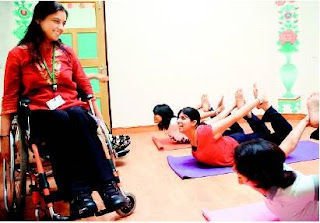 Paralysed below waist in an accident, Pragya Ghildial didn’t lose hope. She is a yoga instructor and counsellor for paralytic patients at Indian Spinal Injuries Centre
 She is a yoga instructor and peer counsellor for paralytic patients at the Indian Spinal Injuries Centre (ISIC) in Vasant Kunj.
Subscribe to:
Posts (Atom)